Review: Bandersnatch

Bandersnatch is a very interesting experience that I’m glad to have played, especially within the context of the class. While there were some aspects I wasn’t thrilled with, I thought it was generally enjoyable.

First off, the Eighties. I love the setting, and they did a good job making the game feel very period. The music, the cars, Tuckersoft, the record store shopping list with The Cure, all of it contributed to the setting and was very enjoyable, even though it isn’t the main focus of the story.

I will have to admit that after playing through a few times, I cheated and looked up whether it was possible to have a positive outcome. Spoiler, it does not. The happiest endings you can have are either your game failing and not going insane, or murdering your father and publishing a five star game, only for the game to be pulled when the murder is uncovered. Both of these endings are, all things considered, not really “happy” endings.

When playing through the game I intentionally picked choices opposite to what we picked in class just to find out how different of a game experience I would get. From what I can tell from this, Bandersnatch is essentially a gauntlet style story with a couple of longer tangents on the side. The authors do a good job of making even wrong choices interesting. I had a scenario in particular where the player breaks the fourth wall by communicating through a computer, which resulted in a dramatic, action movie style fight scene with the therapist and Stefan’s dad.

The game is also interesting in the way it makes you curious to play through multiple times. Some decisions have seemingly no effect when you choose them, but have surprisingly different outcomes later, and some decisions are false, such as one option where I was prompted to spill tea on Stefan’s computer. Selecting the option doesn’t actually result in him doing it in one instance, but it can appear in multiple different scenarios, and it’s intriguing to see if it actually has a different result in those other scenarios.

One criticism I have of the game is that there are no real relief points where the game is even slightly humorous. In all but a few cases that I experienced, the only way to progress successfully is to pick the most fucked up option that feeds into worsening Stefan’s mental state. Any time you pick an option that seems sensible, such as taking your prescription, you’re punished by skipping to an ending where your game posts poor reviews and you have to restart.

Placement wise in the course, I think it was also good to end with Bandersnatch. This game very clearly embodies the message presented in The Garden of Forking Paths, our first reading assignment of the semester. I had never played Bandersnatch before this class, and I know I got more out of it because of this class. It’s also interesting to see the concept of our first reading proliferate into popular culture.

Group Game FaceTime Call

(The video has no audio)

In the call we talked about the premise of the game, including the general storyline, what could be used as potential variables, and how we are going to move forward with making the game. 

Our game is a detective style game where the player and five of their friends are hanging out, and go to a bar where everyone says a little bit more than they should, before going home. The next day, one person calls to make up only to discover one of the friends has died. 

The point of the game is to navigate through several areas and look for clues to discover who the killer is. Once the player has collected enough clues, they can go to the police station to solve the case. Some clues must be found in order to find other clues, and this will be incorporated into the story.

Jessica will focus mostly on the storyline and dialogue, while I will be primarily focused on the mechanics of the game and the formatting.

This is story for our game thus far:

Game: Detective

Characters:

–       Lindsey

–       Hannah

–       Will

–       Kayleigh

–       Sean

–       Eric

Setting:

University of South Carolina Campus

Crime:

Class is over early Friday afternoon. It’s a beautiful day in sunny South Carolina. Everyone decides to have a pool day before hitting the bars. The rest of the afternoon is filled with beer bong, beer pong, pool volleyball and [[a lot of drinking]].

The crew decides to head back to their apartments to get some food and get ready for a night out. All of the girls go back to Hannah’s. They blast their music and try on countless outfits until they find the perfect one. When they are ready to head out, they [[call the guys]].

The six of them go out to their favorite bar, _________, and start ripping shots. Emotions and feelings start flying through the air. Things are being said that cannot be taken back. We’ll see who remembers what they said in the [[morning]].

Kayleigh is the ring leader of the group. She always makes the plans and knows how to get shit done. She knows that last night had a rough ending, so she calls everyone to come over. She’s cooking breakfast and she insists that they wait for Lindsey. Lindsey didn’t answer the phone and hasn’t texted anyone back. The group decides that something is up and decides to [[go to her apartment to get her]].

When they get there, the apartment complex is taped off and cops and ambulance are everywhere. The group begins to panic. “What happened??” “Is Linds ok???” And then they see a body bag being wheeled on a stretcher. Hannah starts screaming and runs up to a cop [[begging to know who it is]].

After hours of not knowing, it was finally revealed that it was Lindsey. The group is distraught. But they are unaware that they are all suspects in the murder investigation.

Rooms:

–       Where body was found (apartment)

–       Pool

–       Bar from night before

–       Police Station

** anything missing from room?

Objects:

–       Murder weapon

–       DNA/finger print

–       Hair follicle/piece of broken nail-       Toxicology report

The Soup Nazi, Outline and Flowchart

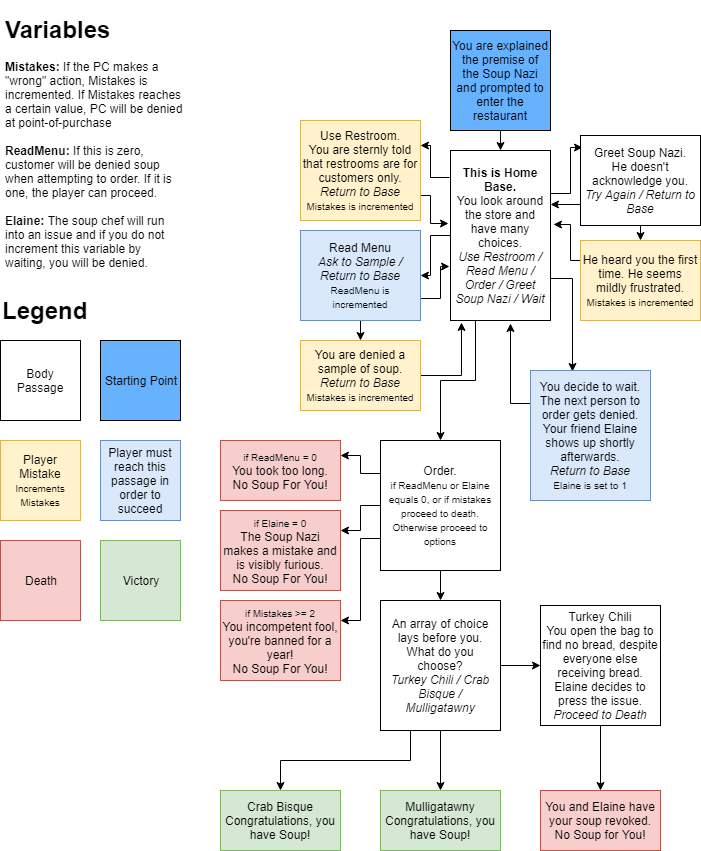
In a nutshell, the goal of my game is to successfully order soup from a very particular and demanding soup chef called The Soup Nazi. As mentioned in my previous blog post, this game is based off of the Seinfeld episode of the same name. What makes ordering the soup so difficult is that the player must meet various conditions to be able to order soup successfully, and the pathway to success is not obvious at first. The goal is for the player to not succeed on the first try. Instead, the player will likely have to make multiple attempts to solve the puzzle of successfully ordering soup. The game is lighthearted and the failures are humorous to make failure funny, encouraging replay.

The player starts out with a quick briefing of the concept of the game, along with some supplemental information about the show it’s based on to aid the player’s understanding. Afterwards, they proceed to the next passage which begins in the restaurant. This passage serves as a “Home Base” where the player will return multiple times. All of the passages stemming from this Home Base eventually loop back to the Home Base, except for the Order passage, which is the pathway to completing the game.

There are three criteria the player must meet in order to progress past the puzzle of ordering soup. First, the player must read the menu. Second, the player must wait, as the Soup Nazi will make a mistake, and the next person served will be denied out of frustration. Third, the player can’t make more than one mistake. There are several ways a player could make a mistake, such as asking for a sample of soup or trying to greet the Soup Nazi. Because of all of these criteria, it will be difficult to successfully meet all of the conditions the first time around, and if the player violates any of these criteria and orders, they will be denied and kicked out, thus ending the game.

If the player meets all of the criteria, the puzzle is solved and the player can select a soup. For the most part, this is it. If you select the Turkey Chili flavor however, you will not receive any bread, and Elaine (your friend who arrives while you were waiting) will press the issue and you will both lose your soup. This is a gag that’s a loose reference to the show, put in there as a laugh for anyone who has seen the episode on which this game is based.

From my perspective, the challenging part of making this game will be the quality of the writing and the delivery. With poor writing, this game could be very shallow and either not have good replay value, which will defeat the purpose, or be too easy to beat, if the goals are made too obvious. Because of this, much of my time making this game will most likely be spent perfecting the writing and dialogue of the game, so that it flows smoothly, adds a challenging aspect to the game, and delivers funny parts at just the right time. For example, if a player reads the menu but fails to wait, they will be denied because they failed to wait. In order to wait, the player could either choose simply to wait, or to use the restroom. Whether or not one seems like the better option is very much up to the writing, and how each option is portrayed. If the Soup Nazi was staring them down, using the restroom may seem like the better option than just waiting around with his judgmental gaze fixed on you, even though simply waiting is the correct choice.

In order for the mechanics of this game to function properly, it will rely on several variables which will be checked or modified at different points in the game that correspond with a decision that was made. This allows for a primitive level of state tracking which will be necessary to determine if the player has already met the conditions to order soup, or if they have made too many mistakes and irritated the Soup Nazi. I also plan on utilizing many of the functions of twine that we have learned so far to add depth to the game in that regard. For example, I plan on using the inter-passage link as a way to deliver the famous “No soup for you!” line when the player fails. This would be useful because I can write a suspenseful passage for which the result isn’t immediately known, and then deliver the outcome while still remaining on the same passage.

Game Pitches

Mods and Rockers

You’re a teenager, living in the heart of London in 1964. Times are good and Mod and Rocker cultures are at an all time high. All of your friends have latched onto one of these two opposing groups. Now it’s time for you to make a choice. Do you side with the Mods, with their clean cut looks and refined taste, or do you side with the Rockers, with their much more rugged and free-spirited attitude?

Once you have made your choice, you must build repertoire with your new acquaintances, or not, as you live the life of a post-war teenager in the sixties. You receive multiple opportunities to take part in parties and other activities, sometimes illegal, with your chosen group. Eventually, tension begins to grow between the Mods and Rockers and word goes around that there will be a riot in Brighton in the coming weeks. Things get worse, and fighting in the street and unsavory interactions become more and more frequent.

As the riots loom closer, you are left with no choice but to take part, as everyone you know will find out if you desert them now. Surely enough, both mods and rockers descend on Brighton and within a couple of days, riots ensue on the beaches. Eventually, police arrive to put an end to the fighting.

Based on the player character’s actions throughout the game, four outcomes are possible:

  • As a Rocker, you are captured by Police and arrested.
  • As a Rocker, an acquaintance offers you a chance to escape at the last second
  • As a Mod, you are arrested. An acquaintance bails you out.
  • As a Mod, you are arrested. None of your friends post bail.

Culinary Critic

You are the owner of an up-and-coming restaurant in a big city. You wake up one day to find out that all hell has broken loose in your restaurant last night. A chef has quit, multiple people are frustrated at each other, and the restaurant is in a general state of disarray. This would be bad enough, but you have an extremely important food critic coming by to review your restaurant this evening. Their review could make or break your restaurant and it’s absolutely critical that they’re satisfied.

Looking at all the things that need to be done, you realize that there’s no way you can get everything back in perfect order by the time the critic arrives, so you must take your list of tasks and use what you know about the critic to decide what things are more important and what the critic is most likely to notice.

As you progress throughout your day, you will run into obstacles that may slow you down or make things worse if they aren’t handled properly. Ultimately, the time will come and the critic will arrive. The critic eats quietly, with very little expression and leaves promptly. The review comes in a week later.

The game ends with the review of the restaurant, with a scale (potentially three or four) of outcomes based on how much the critic liked or didn’t like the restaurant.

The Soup Nazi

Based on the Seinfeld episode of the same name, the goal of this game is to order soup from an obscenely strict soup chef. The game starts when you walk in the door. Every action you take will factor into whether or not you reach your goal of ordering soup. The store is busy, you have to be concise and polite or you will not get the soup you so badly desire. The chef is also extremely idiosyncratic, and some decisions may not appear to have much bearing on your soup-get, but could be critical, make or break decisions. Some choices will get you denied immediately, and some decisions will seal your fate without you knowing until the end. Will you be able to purchase soup?

There is only one successful pathway in this story, and is very linear, encouraging multiple playthroughs. The goal is to make a win on the first try highly unlikely.

Week 1 Class 1: Archer

I’ve found that much of the Intellectual Property I enjoy tends to have a strong humor component, especially when that humor challenges longstanding traditions or approaches an issue in an outrageous way, while still communicating a progressive, tasteful opinion. Works like Blazing Saddles, Seinfeld, and Bojack Horseman all jump to my mind as shining examples of this. However, I also really enjoy spy films, and it just so happens that Archer has a wiki, so I’ve chosen to write this post about that.

Archer is a television series written by Adam Reed and follows the main character, Sterling Archer (H. Jon Benjamin), along with the antics of the rest of the dysfunctional intelligence firm he works for as they find themselves in the middle of escapades they themselves often create. The component I enjoy most about Archer is it’s mockery of the canons of traditional spy/secret agent movies, which it does mainly by emulating them in an ironic way.

Anyone who has seen a Roger Moore era James Bond movie is familiar with the eye rolling moments of not-so-subtle sexism, racism, and self-congratulating “macho man” attitude prevalent in old spy films. Sterling Archer embodies this attitude, but with the added disadvantage that he’s fairly incompetent, and thus gets no passes for his childlike and irresponsible ways and is constantly criticized for his inappropriate comments and loose canon behavior.

Surely there was nothing wrong with 70’s Bond films, right?

Another reason I enjoy Archer is that it is filled to the brim with cultural references. What I can only imagine is a massive cooperation between the artists and writers of the show is the amount of effort put into turning small details into treats for anyone privy to classic pop culture. When just a generic sports car illustration would suffice, Archer is driving an 80’s Ferrari 308 GTB, a car known for its role in Miami Vice. Hunter S. Thompson quotes are peppered throughout the show, both Kenny Loggins and Burt Reynolds have made cameos, and hundreds of other subtle (or not) references to popular music, classic cocktails, and more are made throughout many seasons.

“Would you say we’d be venturing into a Zone of Danger?”

This abundance of references is something I really enjoy and only does good for the show, as it simply doesn’t matter to those who don’t get a reference and provides a great deal of relatable moments for those who do.

The show also benefits from the excellently witty, dry humor of H. Jon Benjamin, who also does voices in Bob’s Burgers as well as some Arby’s Commercials and produced a jazz album featuring Aziz Ansari.

The show’s setting in time is ambiguous however, which may be confusing to some viewers as you often see cell phones and 60’s technology on the same screen. I don’t personally have an issue with it, but I could understand why someone might.

Overall, I think all of these factors together allow Archer to culminate into not just an enjoyable show, but a show with great re-watch value that’s very redeeming and enjoyable to watch.

Design a site like this with WordPress.com
Get started