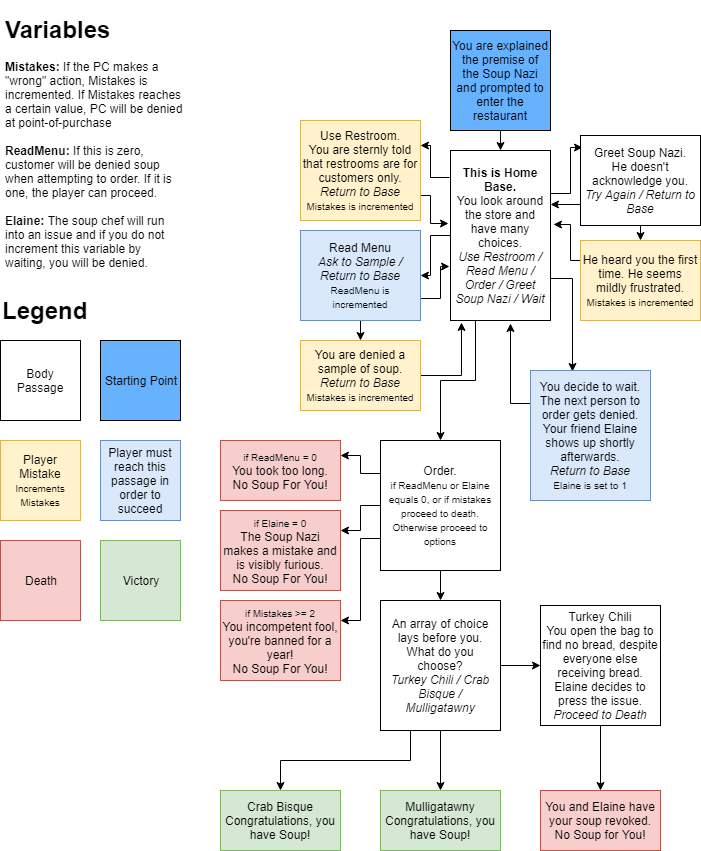
In a nutshell, the goal of my game is to successfully order soup from a very particular and demanding soup chef called The Soup Nazi. As mentioned in my previous blog post, this game is based off of the Seinfeld episode of the same name. What makes ordering the soup so difficult is that the player must meet various conditions to be able to order soup successfully, and the pathway to success is not obvious at first. The goal is for the player to not succeed on the first try. Instead, the player will likely have to make multiple attempts to solve the puzzle of successfully ordering soup. The game is lighthearted and the failures are humorous to make failure funny, encouraging replay.
The player starts out with a quick briefing of the concept of the game, along with some supplemental information about the show it’s based on to aid the player’s understanding. Afterwards, they proceed to the next passage which begins in the restaurant. This passage serves as a “Home Base” where the player will return multiple times. All of the passages stemming from this Home Base eventually loop back to the Home Base, except for the Order passage, which is the pathway to completing the game.
There are three criteria the player must meet in order to progress past the puzzle of ordering soup. First, the player must read the menu. Second, the player must wait, as the Soup Nazi will make a mistake, and the next person served will be denied out of frustration. Third, the player can’t make more than one mistake. There are several ways a player could make a mistake, such as asking for a sample of soup or trying to greet the Soup Nazi. Because of all of these criteria, it will be difficult to successfully meet all of the conditions the first time around, and if the player violates any of these criteria and orders, they will be denied and kicked out, thus ending the game.
If the player meets all of the criteria, the puzzle is solved and the player can select a soup. For the most part, this is it. If you select the Turkey Chili flavor however, you will not receive any bread, and Elaine (your friend who arrives while you were waiting) will press the issue and you will both lose your soup. This is a gag that’s a loose reference to the show, put in there as a laugh for anyone who has seen the episode on which this game is based.
From my perspective, the challenging part of making this game will be the quality of the writing and the delivery. With poor writing, this game could be very shallow and either not have good replay value, which will defeat the purpose, or be too easy to beat, if the goals are made too obvious. Because of this, much of my time making this game will most likely be spent perfecting the writing and dialogue of the game, so that it flows smoothly, adds a challenging aspect to the game, and delivers funny parts at just the right time. For example, if a player reads the menu but fails to wait, they will be denied because they failed to wait. In order to wait, the player could either choose simply to wait, or to use the restroom. Whether or not one seems like the better option is very much up to the writing, and how each option is portrayed. If the Soup Nazi was staring them down, using the restroom may seem like the better option than just waiting around with his judgmental gaze fixed on you, even though simply waiting is the correct choice.
In order for the mechanics of this game to function properly, it will rely on several variables which will be checked or modified at different points in the game that correspond with a decision that was made. This allows for a primitive level of state tracking which will be necessary to determine if the player has already met the conditions to order soup, or if they have made too many mistakes and irritated the Soup Nazi. I also plan on utilizing many of the functions of twine that we have learned so far to add depth to the game in that regard. For example, I plan on using the inter-passage link as a way to deliver the famous “No soup for you!” line when the player fails. This would be useful because I can write a suspenseful passage for which the result isn’t immediately known, and then deliver the outcome while still remaining on the same passage.
 Max's Eng Comp Blog